There is a piece of fabric on my table as I write this post.
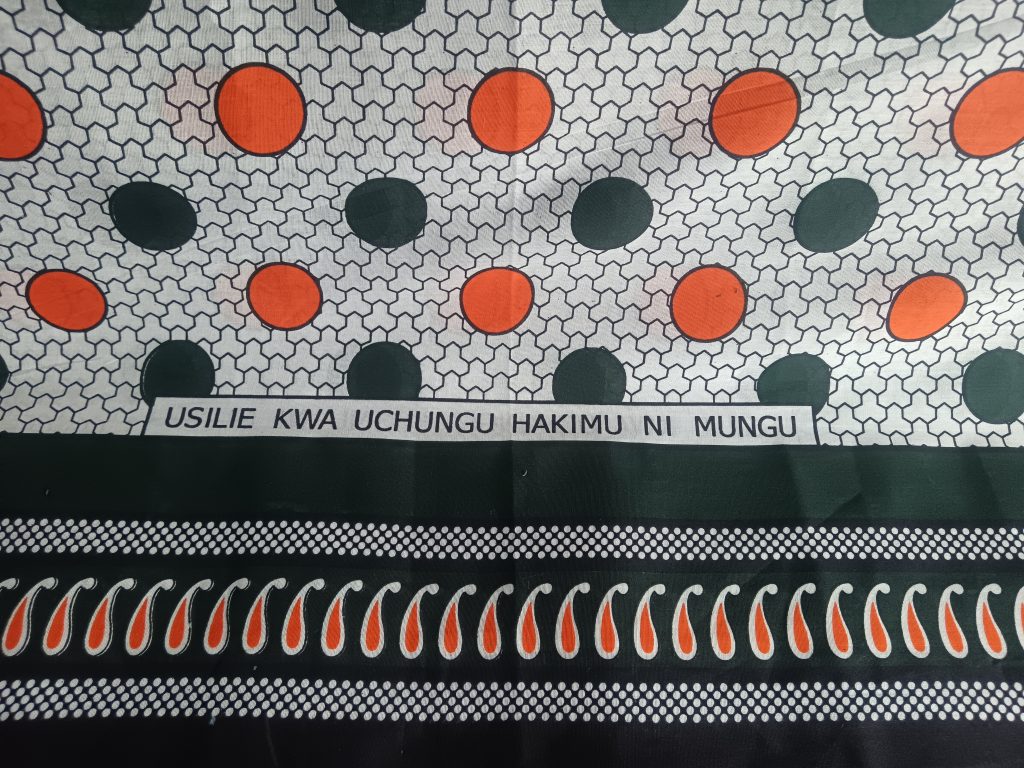
It is a Kanga a printed cotton rectangle in white, deep forest green, and bold orange. The main body is covered in a fine geometric honeycomb pattern with large circles scattered across it in alternating rows of orange and green. Along the lower edge runs a decorative band of orange and white paisley motifs.
And between the pattern and the decorative border, printed in plain black capital letters on a white band, is a sentence in Swahili
USILIE KWA UCHUNGU HAKIMU NI MUNGU.
Do not weep from pain. God is the judge.
I want to tell you exactly what those words mean, why they were printed on this fabric, and what is lost when a Kanga travels to the other side of the world and the sentence along its border is never read.
What a Kanga is
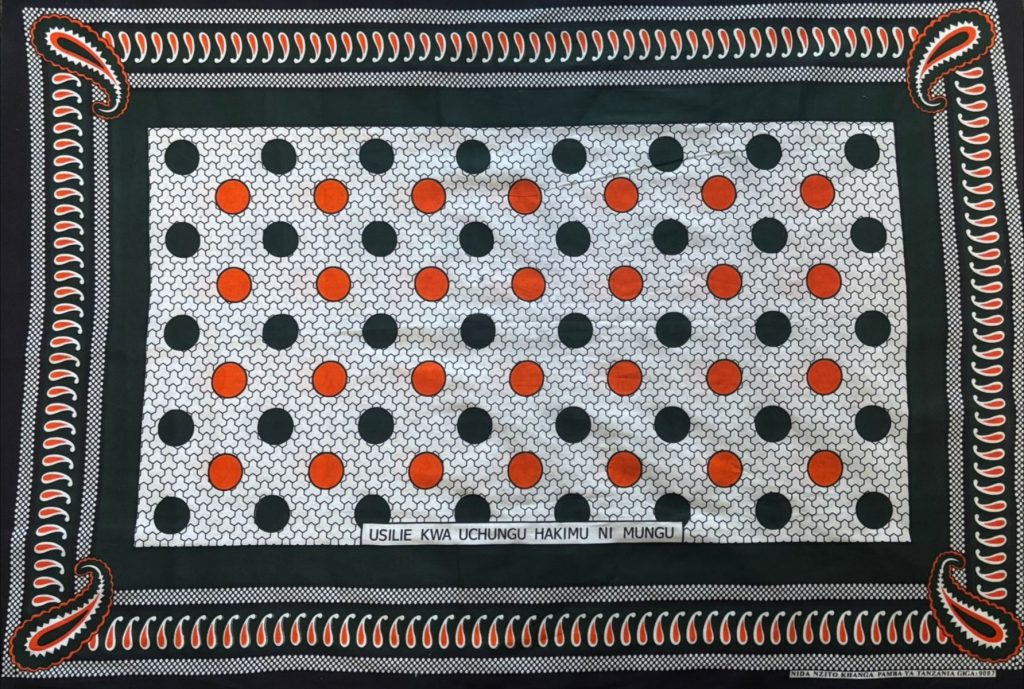
A Kanga is a printed cotton rectangle made primarily in Kenya and Tanzania approximately 150 centimetres by 110 centimetres. It is worn wrapped, draped, tied, or folded. As a skirt, a shawl, a baby carrier, a tablecloth, a head covering, a market bag.
But the defining feature of every Kanga the thing that makes it unlike any other textile in the world is the proverb printed along its border.
Every single piece of Kanga fabric carries a sentence. A Swahili proverb, declaration, message, or question. The sentence is not a branding element. It is the content of the fabric. It is the reason the Kanga was chosen.
The proverb tradition
In Swahili-speaking communities along the East African coast, the Kanga proverb has functioned as a communication system for generations. Women chose specific proverbs for specific people at specific moments wearing them into rooms where direct speech was difficult, or giving them as gifts that said what the giver’s voice could not.
A daughter could not easily challenge her mother directly. A neighbour could not comfortably confront another. A wife could not safely say out loud what she needed her husband to understand.
But the Kanga could say it. Folded carefully. Handed across with both hands. The border speaking what the voice could not.
Decoding the proverb on my table
Usilie kwa uchungu hakimu ni Mungu.
Do not weep from pain. God is the judge.
This is a proverb of consolation, resilience, and faith. It would be given to someone who has been wronged someone suffering an injustice they cannot fight directly, someone in pain without visible recourse.
The person giving this Kanga is saying without the vulnerability of saying it directly, without putting themselves at risk I see what has been done to you. Do not collapse from it. Do not be destroyed by the pain. There is a justice beyond what you can currently reach.
Do not weep from pain. God is the judge.
Imagine receiving that message wrapped in fabric. Imagine unfolding a cloth and reading those words knowing they were chosen specifically for you, for this moment, for this particular wound.
This is what a Kanga carries. This is what the proverb is for. And this is what disappears entirely when the border is treated as decorative typography.
What happens when Kanga travels without its voice
This specific Kanga
the one on my table, with Usilie kwa uchungu hakimu ni Mungu printed along its border could be purchased by someone in the UK who sees only the bold geometric pattern, the striking orange and green circles, the handsome honeycomb background.
The sentence is visible. It is printed clearly in the same place it has always been.
But if it is never read, the fabric arrives mute. The consolation it was designed to carry the specific comfort of do not weep from pain, God is the judge is wrapped around a body that does not know it is being comforted.
This is not a neutral loss. This is the erasure of a communication system that women across East Africa built and maintained across generations for precisely the moments when communication was most difficult and most necessary.
At Ann-Aniedi Asikpo Studio, the story card beside every Kanga garment will include the proverb translated and explained. Because the sentence is the most important part of the fabric.
And every sentence deserves to be read.
#Kanga #SwahiliCulture #EastAfricanTextiles #DecodeAfrica #weaveyourstory #FabricLanguage #AfricanHeritage #KangaProverb